
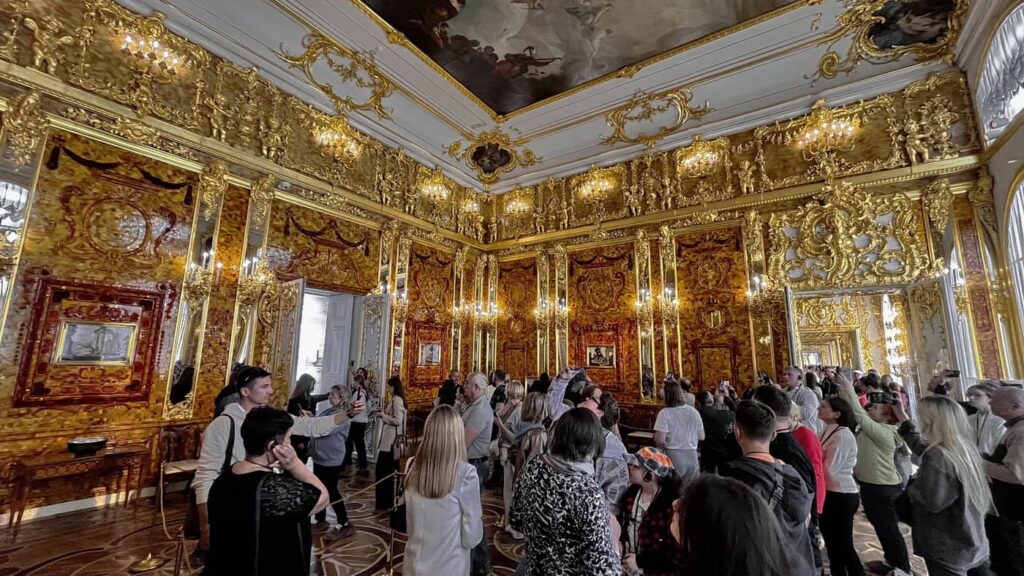
The Amber Room is not just “one of those masterpieces that attract visitors to St. Petersburg.” Quite often, it becomes the very reason people travel here. Beyond its obvious beauty, the Amber Room fascinates with its unusual, rich, and mysterious history. It was gifted and transported, expanded and lost, rediscovered and recreated. It is a riddle — and one that remains unsolved.
The Amber Room in Tsarskoye Selo: Hours, Tickets, and Prices
The Amber Room is located inside the Catherine Palace and is part of the standard visitor routes. It cannot be visited separately, and there are no standalone tickets for the Amber Room. It sits deep within the palace, so every visitor passes through it as part of a full palace tour.

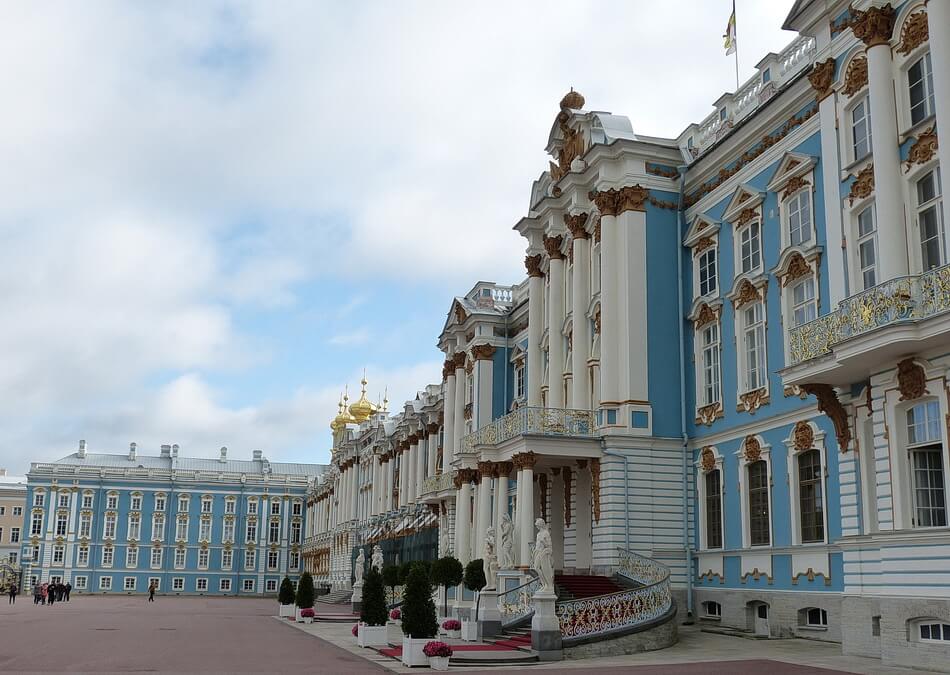
The Catherine Palace
Your visit follows this structure:
- You purchase a ticket to the Catherine Palace for route 1 or 2 (selected during booking).
- You tour the palace either with a guide in a group (included in the ticket price), with a private guide you hire yourself, with an audio guide, or independently.
- Somewhere in the middle of the route, you enter the Amber Room.
Keep in mind that time inside the room is limited — usually just a few minutes, especially during peak season. Staff may allow tour groups a bit more time if the schedule permits and if the guide is well‑known to the museum.

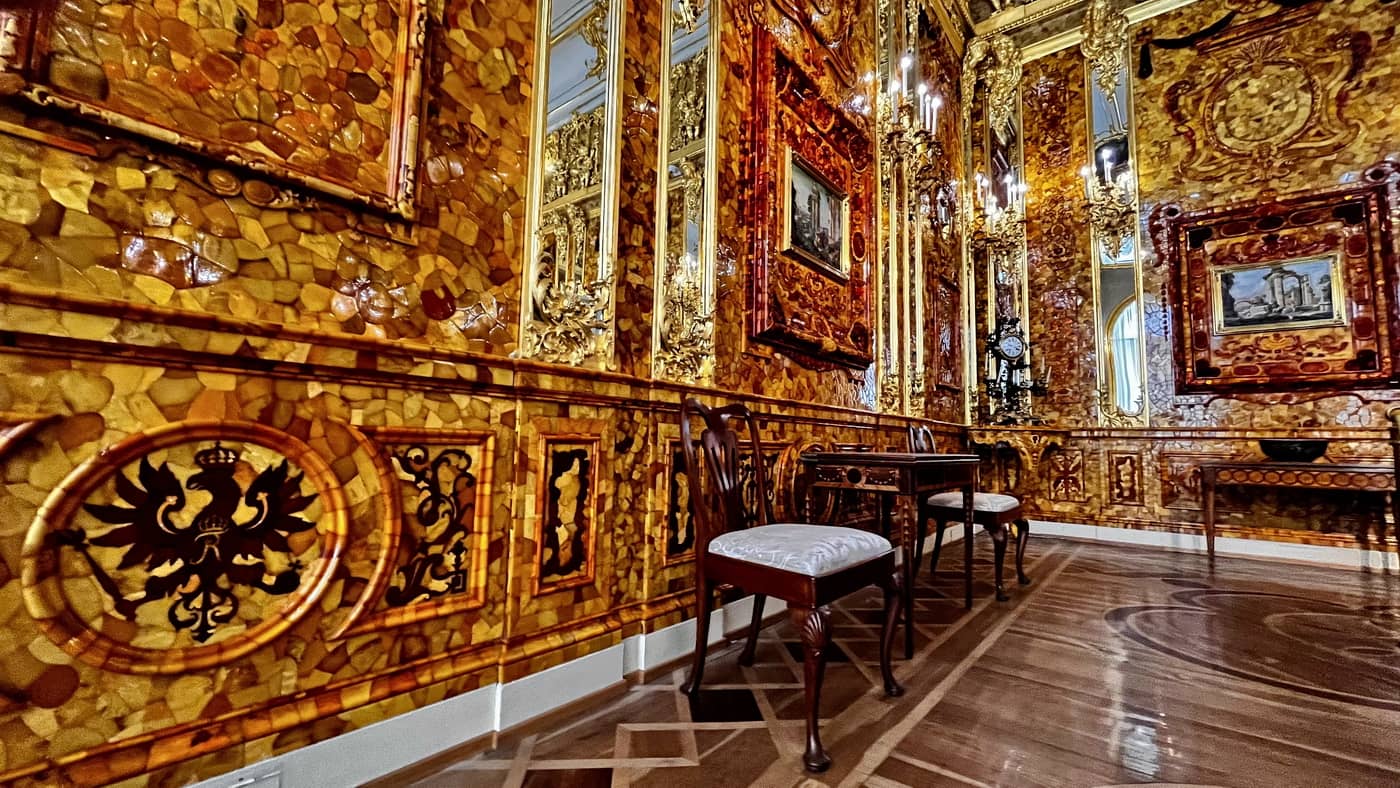
The Northern and Eastern walls of the Amber Room
Route No. 1
The visit includes: the Main Staircase, the Great Hall, the Cavalier Dining Room, the White Formal Dining Room, the Crimson Column Hall, the Green Column Hall, the Portrait Hall, the Amber Room, the Picture Hall, the Small White Dining Room, Alexander I’s Chinese Drawing Room, the Buffet Room, the Green Dining Room, the Servants’ Hall, and the Stasov Staircase.
Route No. 2
The visit includes: the Antechambers, the Great Hall, the Exhibition Rooms, the Main Staircase, the exhibition “The Romanovs in Tsarskoye Selo,” the Amber Room, the Picture Hall, the exhibition “Memorial Rooms of Alexander I,” Alexander I’s State Study, the Vaulted Passage, the Oval Antechamber, the Green Dining Room, the Servants’ Hall, and the Stasov Staircase.
Closed on Tuesdays.

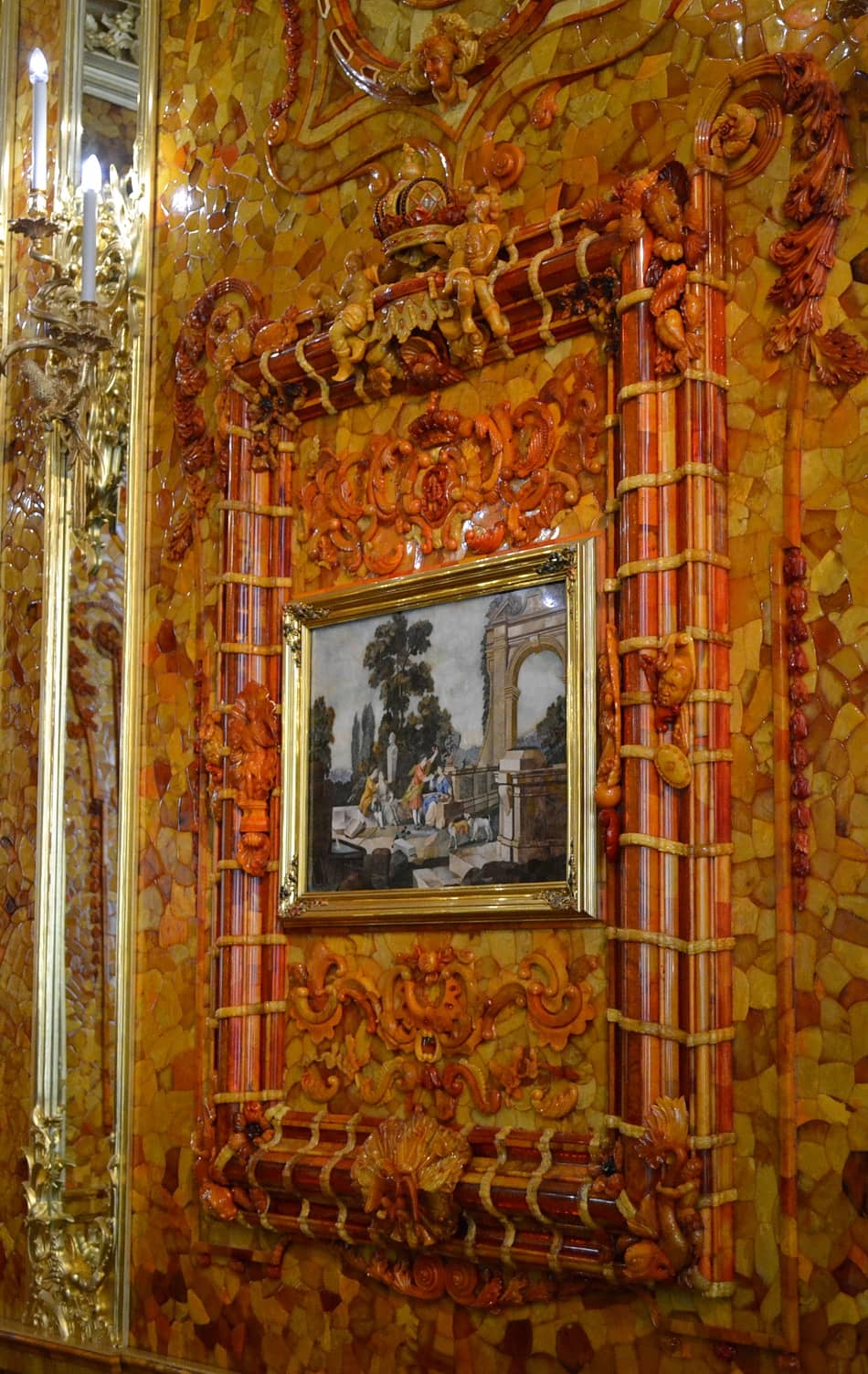
Large frame with sculptural decoration. Painting «Touch and Smell.» Mid-18th century. Florentine mosaic.
Ticket Prices for the Catherine Palace (+ Park)
| Base Rate (2026) for foreign visitors; includes entrance to Catherine Park |
|
|---|---|
| Adults | 2,600 RUB |
| Children 7–14 | 700 RUB |
| Children under 7 | Free |
Catherine Palace Opening Hours
- 10:00–18:00 (ticket office closes at 16:45)
- Closed on Tuesdays
- From November to March: last Monday of the month is a maintenance day

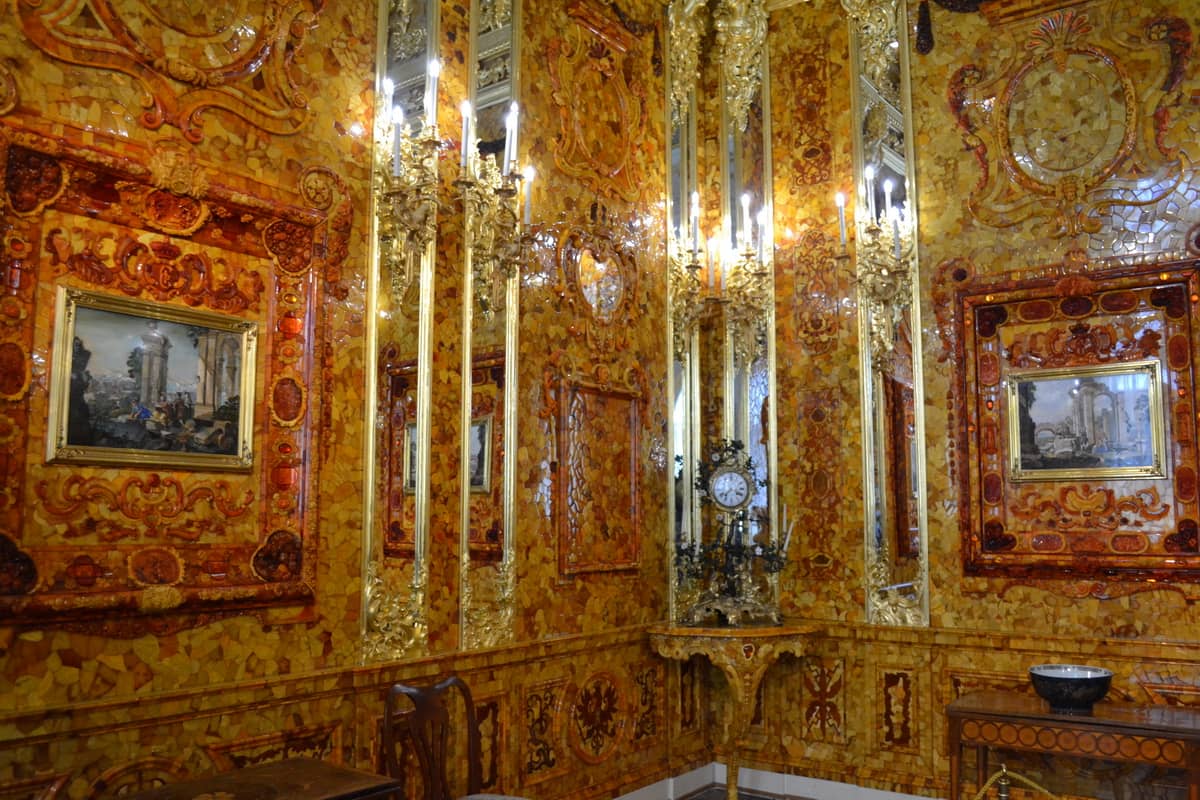
A clock and a large frame with medallions and cameos depicting biblical scenes, engraved landscapes, and Florentine mosaics. The painting «Vision»
History of the Amber Room
The Amber Room — originally known as the Amber Cabinet — was first conceived as one of the interiors of the Lützenburg Palace in Berlin. It was intended as a gift from King Frederick I of Prussia to his wife, Sophia Charlotte. The idea emerged in 1701, but the project was never completed during their lifetimes: Sophia Charlotte died in 1705, and Frederick I passed away four years later.
By 1713, the cabinet still existed only as a set of unfinished amber panels. The reason for such slow progress was the nature of amber itself: it is fragile, sensitive to temperature, and extremely difficult to work with. Transforming it is easy; shaping it precisely and integrating decorative elements is not.
Around 1712–1713, the panels were shown to Peter the Great of Russia, who was known for his fascination with unusual art and craftsmanship. He admired the work, and a few years later received the panels as a gift from Frederick William I, the son of Frederick I. Some accounts suggest the “gift” was compensated with Russian soldiers sent to Prussia.
In 1717, after a long and complicated journey, the amber panels finally arrived in St. Petersburg.
Yet the Amber Cabinet remained hidden from the public for decades. Although it was intended to be displayed at court, Peter the Great placed the panels in the Summer Palace and seemingly forgot about them — an unusual move for a ruler known for his curiosity. Historians speculate that declining health and the overwhelming demands of governance may explain this neglect.
It was Peter’s daughter, Empress Elizabeth, who revived interest in the forgotten panels. She ordered them to be transported to Tsarskoye Selo, which she was actively transforming into her main residence. Elizabeth’s taste leaned toward grandeur and opulence, and the amber panels fit perfectly into her vision for the Catherine Palace.
The room chosen for the Amber Room was significantly larger than the original cabinet, so additional amber elements had to be created. This was a major challenge: amber craftsmanship was virtually nonexistent in Russia, and the only skilled artisans were in Prussia, near Königsberg (modern‑day Kaliningrad), where amber was naturally abundant.
The complex work continued until 1771. From the initial concept to the first full exhibition of the completed masterpiece, nearly 70 years had passed — almost twice as long as the construction of St. Isaac’s Cathedral, one of Russia’s most famous long-term projects.
The finished Amber Room, complete with furniture and décor, was presented to guests by Catherine the Great, who ascended the throne in 1762. Although German by birth, she continued the artistic ambitions of her predecessors and supported the development of Russian craftsmanship. She encouraged local artisans to master amber work, aiming to establish a Russian school of amber art.
Historical accounts describe the room’s debut as a breathtaking spectacle: on the day of its opening, 565 candles illuminated the amber panels, their reflections making the room glow like a chamber of sunlight.
For the next 170 years, the Amber Room remained one of the most admired interiors of the Catherine Palace. It required constant care — amber darkens over time, reacts to temperature, and becomes brittle — but its appearance remained largely unchanged.
Disappearance, Search Efforts, and Reconstruction
When World War II reached Tsarskoye Selo in 1941, the town was occupied by German forces. Museum staff were unable to evacuate the Amber Room: attempts to remove the panels caused the fragile amber to crumble, and transporting them safely was considered impossible.
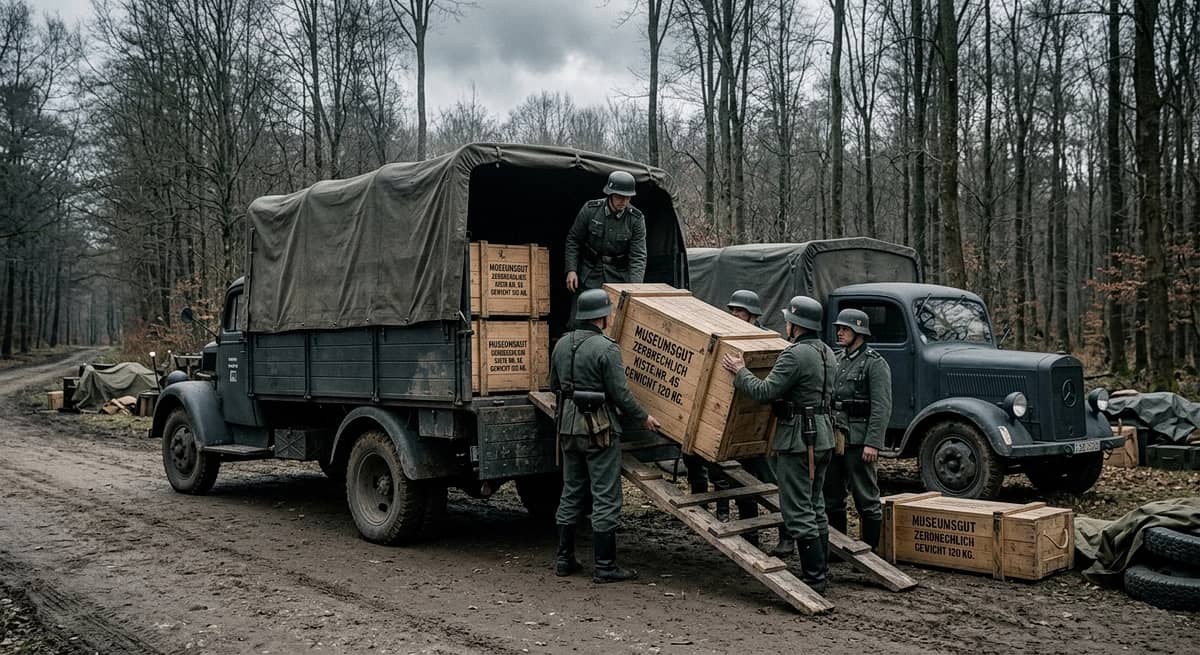

The German military, however, managed to dismantle and pack the room. Believing the Amber Room to be a creation of their own cultural heritage — its origins were tied to Prussia — they transported the interior to Königsberg (modern-day Kaliningrad). The operation appears to have been planned in advance, as specialists were brought to Tsarskoye Selo specifically for this task.
By late 1941, the Amber Room was reassembled and displayed in the Königsberg Castle Museum. Photographs published in the German magazine Pantheon confirmed the installation. Only the original “Prussian” portion was exhibited; the later Russian additions were reportedly sent to Berlin by order of Hitler.
In 1945, Soviet troops captured Königsberg. The castle was taken — but the Amber Room had vanished. It has never been found, aside from a few isolated fragments discovered decades later. Its disappearance remains one of the greatest art mysteries of the 20th century.
The most widely accepted theory is that the Amber Room was destroyed during Allied bombing raids and the subsequent fire that engulfed the castle. Amber melts at high temperatures, making this scenario plausible. Still, many researchers doubt this explanation, and alternative theories continue to emerge.
Some speculate that the panels were packed into crates and secretly transported to Germany or elsewhere in Europe. Others believe they were hidden in mines, tunnels, caves, or underground bunkers. Numerous locations in Germany, Poland, and the Kaliningrad region have been searched — without success.
If the Amber Room survived, no one knows whether it remains in Germany or was moved overseas. Its condition is also uncertain: amber deteriorates in humidity and heat, so decades of improper storage could have caused irreversible damage.
Several individuals dedicated their lives to searching for the Amber Room. One of the most famous was Georg Stein, a former Wehrmacht soldier who had seen the room in Königsberg during the war. He reportedly made progress in his investigation, but died under mysterious circumstances before revealing his findings. His body was discovered in a forest with a fatal knife wound. Although officially ruled a suicide, friends insisted he had been threatened and warned to stop his research.
Another tragic case involved Ivan Kuritsyn, a Soviet security officer who investigated the Amber Room’s disappearance in 1945. He died en route to meet a witness when a wire stretched across the road decapitated him. The witness was later found strangled. The coincidences were so extreme that they seemed almost cinematic.
Not all discoveries were grim. In 1997, a Florentine mosaic titled “Touch and Smell” — originally part of the Amber Room — surfaced in Germany. It had been removed by a German soldier in 1941. His descendant attempted to sell it and was detained. The mosaic was returned to Russia and is now kept in storage; a replica is displayed in the palace.
In the 1990s, an amber chest of drawers from the room was also recovered after someone tried to sell it anonymously at an auction. Experts recognized it from archival photographs, and it was successfully returned.
Today, these two items — the mosaic and the chest — are the only confirmed surviving pieces of the original Amber Room. Both are kept in museum storage, while visitors see a full reconstruction.
The decision to recreate the Amber Room was made in 1979. Work began soon after and continued for more than twenty years, culminating in 2003 for the 300th anniversary of St. Petersburg. The project required six tons of amber and extraordinary craftsmanship.
The reconstruction is remarkably precise. Historical photographs and the recovered mosaic confirmed that the dimensions and decorative elements were recreated down to the millimeter. Visitors today see the Amber Room exactly as it appeared in the time of Catherine the Great and the later Russian emperors.
Today, the Amber Room you see in the Catherine Palace is a full reconstruction — but one created with extraordinary precision and craftsmanship. The project required decades of work, six tons of amber, and meticulous study of historical photographs, surviving fragments, and archival documents. The result is a room that looks exactly as it did in the 18th century, when Catherine the Great welcomed her guests here.
For visitors, the Amber Room remains one of the most unforgettable highlights of Tsarskoye Selo. Even knowing that it is a reconstruction, the experience is no less impressive: the glow of the amber, the intricate carvings, and the sheer scale of the room make it one of the most remarkable interiors in Europe.
Guided Tours to the Catherine Palace and the Amber Room
You can book guided tours to the Catherine Palace — including the Amber Room — through international tour platforms and local operators. These tours typically include palace admission, a guided walk through the main halls, and a visit to the Amber Room as part of the standard route.
