

Saint Petersburg has a well-developed public transport system. To move around the city confidently, it’s important to understand how fares work, which types of transport exist, what determines the price of a trip, and how city transport differs from suburban services.
This guide explains everything in a clear, structured way for international travelers.
1. Metro


The metro is the fastest way to get around Saint Petersburg. It operates roughly from 5:30 AM until midnight.
St. Petersburg metro map


You can view and download the metro map in a larger format here.
The image is taken from the official website of the St. Petersburg metro — https://metro.spb.ru
How to Pay
You pay at the entrance by tapping your card at the turnstile. If the turnstile opens, your trip is paid. There are no additional inspections inside trains or on platforms.
You can pay with:
- a bank card (including phone or smartwatch payments)
- a Podorozhnik transport card
- the Unified Petersburg Resident Card (EKP)
- a single‑ride metal token used in the turnstiles
Metal tokens and Podorozhnik transport card can be purchased at the ticket offices located in the entrance halls of all metro stations.

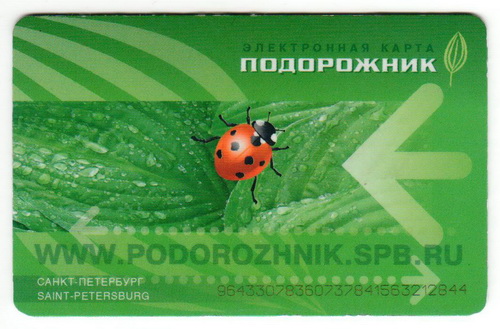
A Podorozhnik transport card
Fares (2026)
- 95 ₽ — bank card / single ticket
- 65 ₽ — Podorozhnik
- 65 ₽ — EKP
The price does not depend on distance or the number of stations. There is no transfer fare inside the metro: every entry through a turnstile counts as a new trip.
2. City Buses, Trams, and Trolleybuses


This includes all municipal surface transport within the administrative borders of Saint Petersburg, including remote districts such as Pushkin, Kolpino, Peterhof, and Kronstadt.
How to Pay
Several validators are installed throughout the vehicle. Passengers tap their Podorozhnik, bank card, or EKP at any validator.
How Inspections Work
Inspections are route-based. Inspectors do not ride every vehicle; instead, they selectively board different buses, trams, and trolleybuses along the route.
Typically:
- two inspectors enter the vehicle
- they check payment from all passengers
- if a trip is unpaid, the fine is collected on the spot
Fares (2026)
- 88 ₽ — bank card / cash / single ticket
- 65 ₽ — Podorozhnik
- 65 ₽ — EKP
The price does not depend on distance or the number of stops.
60-Minute Transfer Fare (Podorozhnik Only)
This transfer system works only on surface transport.
How it works:
- Your first trip costs 65 ₽.
- If you board another bus, tram, or trolleybus within 60 minutes, the second trip costs 14 ₽.
- All additional trips within the same 60-minute window are free.
Transfers between the metro and surface transport are not included in this fare.
3. Suburban Minibuses (Commercial “Marshrutki”)
There are no commercial minibuses operating within Saint Petersburg. Instead, marshrutki run between the city and the Leningrad Region.
The word marshrutka comes from the Russian word marshrut, meaning “route.” These vehicles are typically small commercial minibuses such as Ford Transit, Mercedes Sprinter, or GAZelle Next. In recent years, however, many of these European models have been replaced by similar Chinese-made minibuses, which now dominate most suburban routes.
Key Features
- They stop at official stops and also on demand — you can ask the driver to stop anywhere along the route.
- Fares are set by the private operator.
- The price depends on distance.
- Payment is usually made in cash to the driver.
- Bank cards are accepted inconsistently.
- Podorozhnik and EKP do not provide discounts.
4. Suburban Trains


Suburban trains connect Saint Petersburg with nearby towns and the wider Leningrad Region.
How to Pay
You can buy a ticket:
- at a ticket office
- at a self-service terminal on a station
- in the Russian Railways (RZD) mobile app
- from a conductor on board (with a surcharge)
How Inspections Work
Tickets are always checked:
- major stations have turnstiles
- after passing the turnstile, your ticket will still be checked on board
- smaller stations have no turnstiles — conductors check tickets directly in the train, often more than once per trip
Fares (2026)
Within Saint Petersburg
A single fixed fare applies:
65 ₽ per trip
The price does not depend on distance or train type.
Outside the City
The fare depends on:
- distance
- tariff zone
- train type:
- regular suburban train
- high-speed Lastochka
- high-speed Finist
High-speed trains are more expensive when traveling outside the city limits.
Popular Tourist Destinations
- Pushkin (Tsarskoye Selo) — Vitebsk Line
- Pavlovsk — Vitebsk Line
- Peterhof (New Peterhof) — Baltic Line
- Oranienbaum / Lomonosov — Baltic Line
- Zelenogorsk — Finland Line
- Sestroretsk — Finland Line
- Vyborg — Finland Line
- Gatchina — Vitebsk or Baltic Line
5. Podorozhnik: What It Is and How It Works
The Podorozhnik card is Saint Petersburg’s universal transport card, similar to London’s Oyster or Tokyo’s Suica.
What It Offers
- metro and surface transport trips for 65 ₽
- access to the 60-minute transfer fare
- the ability to load monthly passes
- payment on suburban trains (no city discounts)
Where to Buy
- metro ticket offices
- Organizer of Transportation kiosks
- MTS, Megafon, Beeline, and T2 mobile stores
- Pulkovo Airport
Cost
- 100 ₽ — card price
- top-up — any amount
There are no vending machines selling new cards — only top-up terminals.
6. Unified Petersburg Resident Card (EKP)
This is a social card for city residents. Foreign visitors do not need it.
Fares are the same as Podorozhnik:
- 65 ₽ — metro
- 65 ₽ — surface transport
7. Travel Passes (Brief Overview)
Saint Petersburg offers:
- monthly passes (metro, surface, or combined)
- 1-, 3-, and 5-day unlimited passes
- various discounted passes for eligible residents
Tourists don’t necessarily need a pass, but it can be cost-effective for active travel.
8. Long-Distance Trains


Long-distance trains depart from five major stations:
- Moskovsky — Moscow, Kazan, Nizhny Novgorod
- Ladozhsky — Murmansk, Arkhangelsk, Vologda
- Vitebsky — Pskov, Veliky Novgorod
- Finlyandsky — Vyborg
- Baltiysky — Kaliningrad (via Lithuania), seasonal routes
Tickets are sold by seat (sitting, compartment, or open-plan). Prices depend on distance and class. You can buy tickets online, in the RZD app, or at station ticket offices.
You can read our post Aurora Train Between Moscow and St. Petersburg.
9. Intercity Buses


Intercity buses depart from:
- Central Bus Station (Obvodny Canal, 36)
- Northern Bus Station (Devyatkino)
Most routes are operated by private companies. Prices vary by destination and carrier. Some companies charge separately for luggage.