In 2026, Russia has seen an unusually alarming number of brown bear attacks on people. By late September, Russian media reports and investigative authorities had put the death toll at more than 20, with at least 11 others injured. Incidents had been reported in at least 11 regions, stretching from Kamchatka and Khabarovsk Krai in the Far East to Vologda Oblast in the northwest.
Among those killed was the father of Andrei Kuzmenko, a forward for the Pittsburgh Penguins of the National Hockey League. In one small Siberian town, bears repeatedly appeared near residential areas, prompting local authorities to take emergency measures.
But does this troubling picture mean that foreign visitors planning a trip to St. Petersburg, Peterhof, Pushkin, or Kronstadt should be concerned? Let’s look at where the attacks are happening, what may be behind the increase, and what precautions travelers should take when venturing into the countryside.
What Is Happening Across Russia?
The death of Kuzmenko’s father was one of the year’s most widely reported incidents. He had traveled to Tuva, a republic in southern Siberia near the Mongolian border, to fish on the Bolshoy Yenisei River. Trips to remote areas where other people and reliable cell service may be nowhere nearby are a traditional form of outdoor recreation in Russia, but they also carry risks when it comes to encounters with wildlife. A bear attacked him on the riverbank, and hunters later shot the animal.
Geography is important for international visitors to understand. Tuva is about 2,500 miles from Moscow. It is a remote region with vast, sparsely populated areas. An incident there does not reflect the level of risk faced by visitors walking through central St. Petersburg or visiting its main attractions.
Another alarming situation unfolded in Khakassia, where bears began appearing near homes in the town of Abaza, often at night. Local authorities declared a state of emergency, organized patrols involving hunters, and used drones equipped with thermal imaging cameras to search for the animals.
In late August, another tragedy occurred in the Altai Republic: a bear pulled a woman from her tent and killed her. This case is particularly relevant to travelers planning camping trips in the wilderness. Unlike St. Petersburg, the Altai region attracts visitors seeking remote mountain and forest landscapes.

Bear attacks have occurred in Russia before. The country has extensive forested areas and a large brown bear population. However, the scale of the incidents reported in 2026 has attracted particular attention from the authorities and the media. Krasnoyarsk Krai, where six people were killed, was among the hardest-hit regions. Other areas reporting serious incidents included Buryatia, Kamchatka, Khabarovsk Krai, Irkutsk and Tomsk oblasts, Tuva, the Altai Republic, and Vologda Oblast.
The situation in Leningradskaya Oblast, the region surrounding St. Petersburg, looks different. According to reports published at the time, no fatal bear attacks on people had been officially confirmed in the region in 2026. Bears had nevertheless been spotted near populated areas. In one incident in Vsevolozhsky District, a bear struck a cyclist with its paw.
This illustrates an important distinction: Leningrad Region does have forests where bears live, but incidents there should not automatically be taken as an indication of danger in St. Petersburg or along its main tourist routes.
Where Do Bears Live in Russia?
Russia is one of the world’s major habitats for brown bears, and its vast forested territories vary considerably in landscape, population density, and wildlife numbers. Estimates of the bear population differ. Specialists point out that existing counting methods cannot provide a completely precise figure.
There is also a geographical detail worth understanding: the taiga is not confined to Siberia or to areas east of the Ural Mountains. Coniferous and mixed forests, wetlands, and sparsely populated areas begin much closer to St. Petersburg than visitors unfamiliar with Russia’s geography might expect.
According to estimates cited in the original sources, around 3,200 brown bears live in Leningradskaya Oblast (Leningrad Region). They are more commonly reported in the eastern and northeastern parts of the region, including Podporozhsky, Tikhvinsky, Lodeynopolsky, Volkhovsky, and Boksitogorsky districts, as well as Luzhsky and Vyborgsky districts.
For travelers, the key consideration is not the exact number of bears but the type of terrain they plan to visit. A trip into a remote forest or a camping excursion requires more caution than a visit to a developed tourist attraction. At the same time, no part of the region should be considered completely bear-free simply because of its location.
Bears are also widespread in Karelia, a neighboring republic known for its natural landscapes and attractions such as the islands of Valaam and Kizhi. Reports cited in the original sources stated that no bear attacks on people had been officially recorded in Karelia in 2026. However, the absence of reported incidents does not mean that bears are absent or that there is no risk when exploring the forests.
The Russian government and regional agencies regulate bear populations, including through hunting quotas. According to the figures cited in the original sources, the quota for Leningradskaya Oblast for the 2026–2027 hunting season is 729 bears.
This figure represents the number of bears that may legally be harvested, not a guarantee that this many will be killed. Nor is it a measure of the risk to visitors. The question of population control remains part of a broader debate about how to reduce dangerous encounters between people and wildlife.
Why Are Bears Coming Closer to People?
Russian specialists have discussed several possible explanations for the increase in attacks. It is important to remember that multiple factors may be involved, and the available reports do not establish that each one has the same effect in every region.
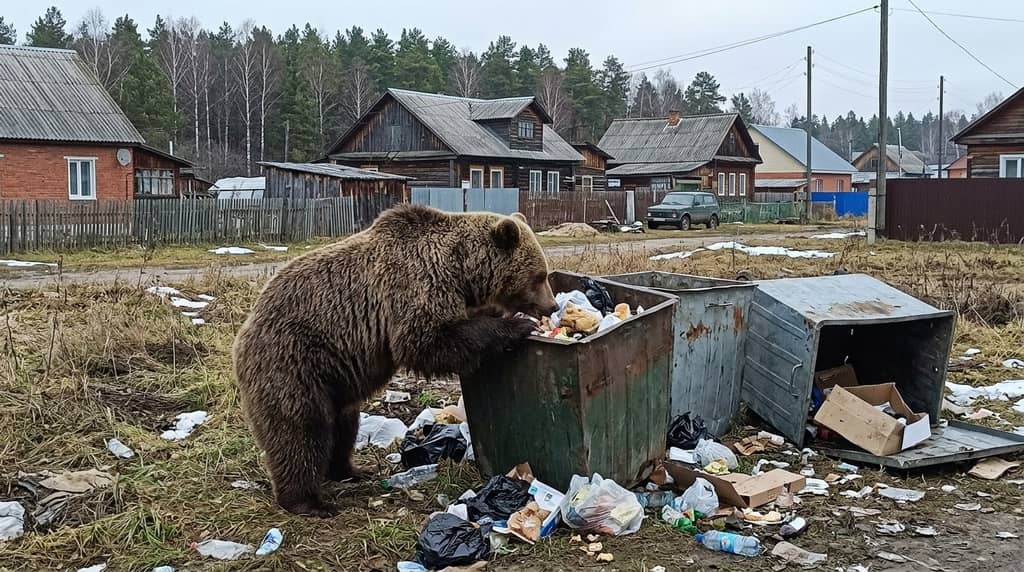
The first is access to food. Unsecured trash containers, garbage dumps, and food left behind at vacation homes or campsites can attract bears to residential areas. If an animal repeatedly finds food near people, it may become accustomed to this source and return more often.
This is not a problem unique to Russia. Similar situations have been documented in national parks in the United States and Canada. That is why visitors are advised to dispose of food waste properly and store food where wildlife cannot reach it.
A second possible factor is a shortage of natural food. In 2026, some Russian regions reported poor crops of berries, pine nuts, and acorns. When their usual food is scarce, bears may search more actively for something to eat, including near human settlements. However, the importance of this factor needs to be assessed region by region; it should not be treated as a universal explanation for every attack.
A third theory concerns hunting. Some specialists suggest that a decline in the number of hunters may have weakened a factor that once helped keep bears away from people. This remains a proposed explanation rather than an established cause.
Waste collection has also become part of the discussion. Russia introduced a major reform of its municipal waste management system in 2019. In Krasnoyarsk Krai, regional officials publicly called for improvements to waste collection and transportation so that garbage sites would not attract bears.
When trash remains accessible for long periods, it can become an additional food source for wildlife. However, it would be misleading to attribute the nationwide increase in bear attacks directly to the waste reform without further evidence.
In short, possible explanations include access to human food, changes in natural food supplies, and other factors affecting interactions between people and wildlife. The available reports do not establish a single cause that explains all the incidents recorded in 2026.
How Safe Is St. Petersburg?
For visitors planning to explore central St. Petersburg, visit museums, dine at restaurants, walk along the waterfront, and see the city’s main attractions, reports of bear attacks in remote parts of Russia are not, in themselves, a reason to cancel a trip. The reports cited in this article did not document bear attacks on people within the city in 2026.
It is important, however, not to confuse St. Petersburg with Leningradskaya Oblast. They are two separate federal subjects of Russia: the city itself and the surrounding region, which includes extensive forested areas.
Peterhof, Pushkin, and Kronstadt are administratively part of St. Petersburg, not Leningradskaya Oblast. Their main tourist attractions—palace and park complexes, museums, and historic districts—are not places where visitors would normally expect to encounter wild bears.
The situation can be different when traveling beyond the city, especially on independent hikes, camping trips, or walks along remote forest trails in Leningrad Region or Karelia. In these areas, visitors should pay attention to local warnings, consider the nature of their route, and follow wildlife safety guidelines.
Authorities in Leningrad Region use population management measures, monitor reports of bears approaching settlements, and issue warnings through local administrations. However, hunting quotas should not be interpreted as a guarantee that bears will be absent from a particular area.
What Should You Do if You Encounter a Bear?

Russia’s Ministry of Emergency Situations (EMERCOM) publishes guidance on what to do when encountering a bear. Travelers heading into the forest or planning an overnight camping trip should keep a few basic rules in mind:
- Do not run or try to approach the animal.
- Do not throw objects at the bear or try to scare it by shouting at close range.
- Avoid sudden movements. Assess the situation calmly and try to back away slowly without turning your back on the animal.
- Whenever possible, hike in a group and talk as you walk so animals can hear you approaching.
- Do not leave food or waste at your campsite, and do not store food inside your tent.
These precautions cannot guarantee safety in every encounter. A bear’s behavior depends on the circumstances, including how close you are and whether cubs are nearby. Before setting out, check the latest guidance from local wildlife authorities.
Most of the incidents discussed in this article occurred between spring and fall, when bears are active and searching for food. However, seasonality is no substitute for assessing the risks of a particular route. It does not mean that the risk of encountering a bear in the forest is zero at other times of year.
So, Should You Still Visit St. Petersburg?
Yes. Reports of bear attacks in Siberia, the Russian Far East, and other parts of the country do not, by themselves, provide a reason to cancel a trip to St. Petersburg. Visiting the historic city center, museums, palaces, and developed parks is very different from hiking through remote taiga wilderness.
If you plan to extend your trip with excursions into the forests of Leningrad Oblast or Karelia, research your route in advance, follow local guidance, and handle food and waste responsibly.
The main takeaway is simple: for a trip to St. Petersburg, ordinary travel precautions matter far more than alarming reports from remote corners of a vast country. But if you are planning an independent hike into the wilderness, bears are a real consideration.
Sources
- Russian newspaper report on the fatal bear attack in Tuva: https://rg.ru/2026/09/28/reg-sibfo/v-tuve-likvidirovali-medvedia-ubivshego-trenera-aleksandra-kuzmenko.html
- Report on bear encounters in Abaza, Khakassia: https://www.krsk.kp.ru/daily/27713/5306247/
- Report on the fatal attack on a tourist in the Altai Republic: https://tolknews.ru/respaltay/obsestvo/226306-kakie-novie-podrobnosti-poyavilis-o-napadenii-medvedya-na-turistku-na-altae
- Overview of bear attacks in Russia: https://fedpress.ru/article/3453448
- Report on bear activity in Leningradskaya Oblast: https://www.fontanka.ru/2026/09/26/76660699/
- Official Leningradskaya Oblast document on bear hunting quotas: https://lenobl.ru/gubernator/npa_pravo/124024/
- Report on proposed regional bear population limits: https://www.pnp.ru/social/v-minprirody-predlozhili-vvesti-normativy-chislennosti-medvedey-dlya-kazhdoy-mestnosti.html
- Russian Ministry of Emergency Situations: Bear encounter safety guidance: https://17.mchs.gov.ru/deyatelnost/poleznaya-informaciya/pamyatki/pamyatka-o-pravilah-povedeniya-pri-vstreche-s-medvedem
