St. Petersburg Metro (subway) is not very hard to use, though you have to keep in mind some moments. That’s the fastest way to get from A to B throughout the city, and many stations are true pieces of art. Fare is 65-95 rubles depending on the means of payment.
Lines And Travel Time
The St. Petersburg’s Metro runs five lines with interchanges between them (see the map). Each of them has its official name, but the locals refer to them by the names of the colors: red instead of Kirovsko-Vyborgskaya, blue instead of Moskovsko-Petrogradskaya, etc.
Most of the stations are located underground and four – Devaytkino, Kupchino, Rybatskoe, Parnas – on the ground.
Recent developments: in December 2025, two new stations — Yugo-Zapadnaya and Putilovskaya— have been added to the network.

You can view and download the metro map in a larger format here. The image is taken from the official website of the St. Petersburg metro — https://metro.spb.ru
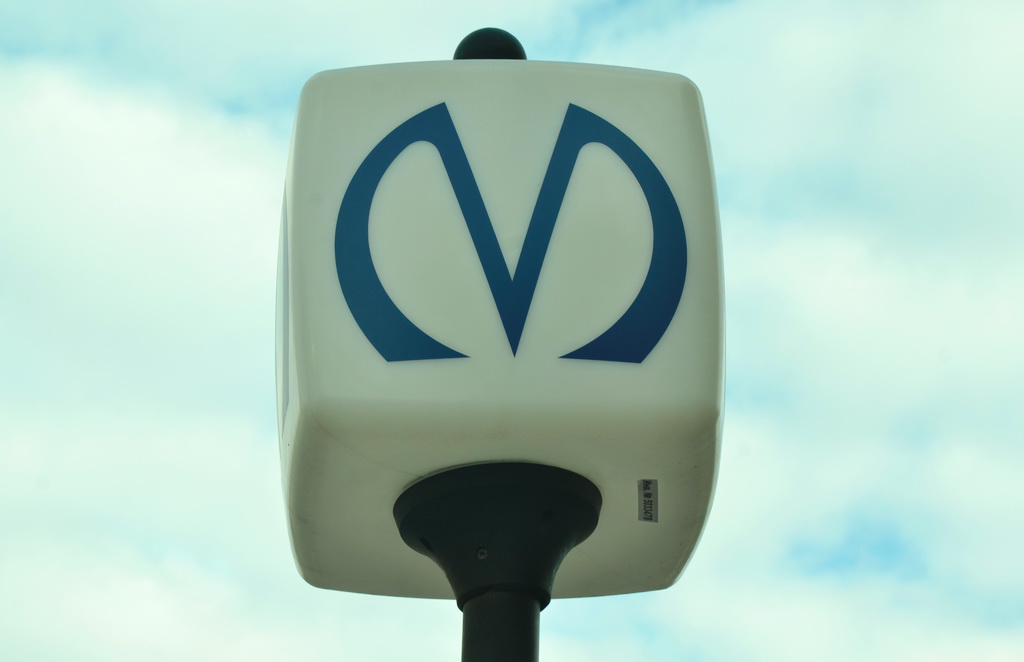
Finding an entrance to a station on the street is easy by the mark M (on the photo below).
Stations open every day at 5.30-5.45 and close at 00.00 – 00.45 depending on station. A full listing of stations with their timetables you can find at http://www.metro.spb.ru/rejimrabotystancii.html (in Russian).
If a station has two entries/exits, one of them can be closed earlier, at 20.00 or 22.00 for example. For instance, Dostoevskaya closes at 20.00. In this case, you can enter Vladimirskaya station that’s combined with Dostoevskaya and then pass to the trains departing from Dostoevskaya.
Travel time in St. Petersburg Metro varies depending on the period. On weekends, early in the morning (till 08.00 am) and late at night (after 20.00), trains go a bit faster, albeit a bit more rarely.
Travel time (approximately)
- Prospect Veteranov — Devyatkino (the red line) — 50-60 minutes;
- Kupchino — Parnas (the blue line) — 50 minutes;
- Rybatskoe – Primorskaya (the green line) — 35 minutes;
- Shushary – Komendantsky prospect (the violet line) — 48 minutes;
- Dybenko – Spasskaya (the orange line) — 20 minutes.
Fare And How To Pay
St. Petersburg Metro is a single travel zone. A ticket is valid since the moment you have entered and until you have gone out through a turnstile no matter how long you had been inside and how long you had traveled.

Fare for a single trip by token (the items pictured above) or by bank card is 95 rubles (as of May 1, 2026). You can buy a travel card which gets you a trip for just 65 rubles or less (depending on the number of trips).
There are a few types of travel cards with different numbers of trips and days the ticket is valid for. We recommend two options:
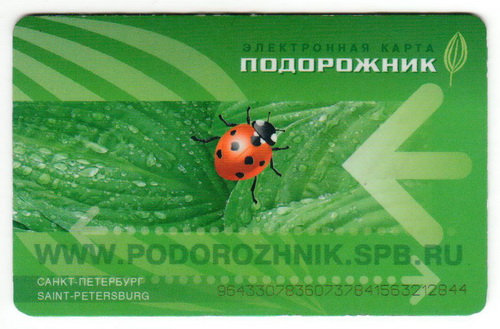
1) Travel card Podorozhnik (the one shown above). Podorozhnik travel cards come with different designs, and the card is also available as a keychain version. The keychain costs 100 rubles instead of the standard 80.
Purchase it at a ticket-office at a subway station for 80 rubles, put some money (up to 15.000 rubles) on it and use it as an “electronic wallet” when paying for transportation. Podorozhnik is valid both for underground and overground public transport.
You can recharge this both at a ticket-office and online here: https://podorozhnik.spb.ru/
Important. You can get back your 80 rubles paid for the card (though it’s still troublesome, only at one spot in the city, and hardly worth it), but you’ll not have refunded your money left on it. Of course, as the card is valid for 3 years since the purchase you have a chance to spend them, but only in case you come back to the city within this period.
2) Time-limited travel passes for 1, 3, and 7 days are available in 2026. A time‑limited travel pass can be added to a Podorozhnik card only when the card is empty and has no other tickets recorded on it.
A travel pass costs:
1 day — 364 rubles
3 days — 701 rubles
7 days — 1240 rubles
A travel pass, valid on all public transport (tram, city buses, trolleybus, metro) in St. Petersburg, provides you with unlimited travel within a period you paid for.
You can purchase tokens and cards/recharge cards at a ticket office and with the help of automated machines (on the photo below).

Automated machines can recharge your cards. Please note that machines may differ in appearance, as the metro uses multiple models
Some Tips, The Busiest Stations And Lines
Important. One of the stations, Tekhnologichesky institut (Technology institute), is designed not like the others, and this can confuse you or even send you in the wrong direction.
What’s the difference and why it’s important to know? When you’re coming from station A to a traditional station B, then cross the platform to take a train, you’ll come back to station A. In the case of Technologichesky institut it works in another way. See the map of the metro above. If you come to Technologichesky institut from the direction of Kupchino (for example, from Moskovskaya), then cross the platform and catch a train, you’ll go up along the red line in the direction of Devaytkino. And on the contrary, if you come from the direction of Devyatkino and cross the platform, you’ll go further down the blue line. It’s been done to reduce transition time and the number of movements a passenger has to make.
When choosing a hotel, keep in mind a few busiest stations and routes. First of all, it’s right for the red line between Prospect Veteranov and Tekhnologichesky institut. Prospect Veteranov is in the center of a huge urban area serving more than a million inhabitants. Crowds are flooding the station every morning on weekdays, and sometimes people at the next station Leninsky prospect cannot get into an overcrowded wagon. We would recommend you to avoid this stretch of St. Petersburg Metro system if you plan your trip between 07.30 and 09.00.
Other difficult stations are Prospect Prosvestchenya and Vasileostrovskaya, both in the morning and in the evening. Less occupied lines are the violet (except Staraya Derevnya and Kommendantsky prospect stations) and the orange ones.
Metro Stations Near Museums, Monuments, Railway Stations, Squares
Theatres
| The Mariinsky theater |
Sennaya ploschad / Spasskaya / Sadovaya |
| The Mikhailovsky theater |
Nevsky prospect / Gostiny dvor |
| Capella Nevsky prospect |
Nevsky prospect / Gostiny dvor |
Museums
| The Hermitage |
Admiralteyskaya |
| The Russian museum |
Nevsky prospect / Gostiny dvor |
| The Dostoevsky’s museum |
Dostoevskaya / Vladimirskaya |
| The Pushkin’s museum |
Admiralteyskaya / Nevsky prospect |
| The Peter and Paul fortress |
Gorkovskaya |
| St. Isaac’s Cathedral |
Admiralteyskaya |
| Kazan Cathedral |
Nevsky prospect / Gostiny dvor |
| Church of the Savior on Spilled Blood |
Nevsky prospect / Gostiny dvor |
Squares
| Dvortsovaya (Palace) square |
Admiralteyskaya |
| Vosstanya (Rebellion) square |
Ploschad Vosstanya |
| Alexander Nevsky’s square |
Ploschad Alexandra Nevskogo |
| Ploschad Iskusstv (Arts square) |
Nevsky prospect / Gostiny dvor |
Railway stations
| Moskovsky |
Ploschad Vosstanya |
| Finlayndsky |
Ploschad Lenina |
| Ladozhsky |
Ladozhskaya |
| Baltiysky |
Baltiyskaya |
| Vitebsky |
Pushkinskaya / Zvenigorodskaya |
Airport
Venues
| Yubileyny Dvorets (Sport Palace Yubileyny) |
Sportivnaya |
| Petrovsky Stadium (Zenit football club stadium) |
Sportivnaya |
| Sport Concert Complex (SKK) |
Park Pobedy |
| Ledovy Dvorets (Ice-hockey and concert Palace) |
Prospect Bolshevikov |
| Sibur Arena (basketball and concerts) |
Krestovsky Ostrov |
| Krestovsky stadium (Gazprom Arena) |
Krestovsky Ostrov |
Also make sure to read our guide Public Transport in Saint Petersburg: A Clear Guide for Foreign Visitors.
If you have any questions, don’t hesitate to ask them here, in the comments.
